Every employer evaluating earned wage access in Pakistan eventually asks the same question. If employees can access part of their salary early, will that become a habit rather than an occasional relief. It is a fair question, and one that deserves a direct answer before any procurement decision is made.
Financial wellness benefits are still new to most Pakistani enterprises. HR Directors and CFOs have seen informal lending cause real damage inside their workforce: repeat borrowing, rising debt, and employees quietly falling behind. It makes sense to ask whether a regulated version of early salary access could create the same pattern under a different name.
The honest answer is that dependency is not an inevitable outcome of earned wage access. It is a design choice, and the design determines the outcome.
Neem Paymenow caps how much of their earned income employees can access in any pay cycle. Employees cannot withdraw more than they have already earned, and there is no rollover, no compounding, and no interest involved. Employers can set that cap by department or employee group, and can pause access altogether for individual employees through the employer dashboard.
This is a structural difference from informal lending. There is no lender extending credit against future income. There is no growing balance. Once an employee is paid, the amount accessed early is reconciled automatically at payroll, and the cycle resets.
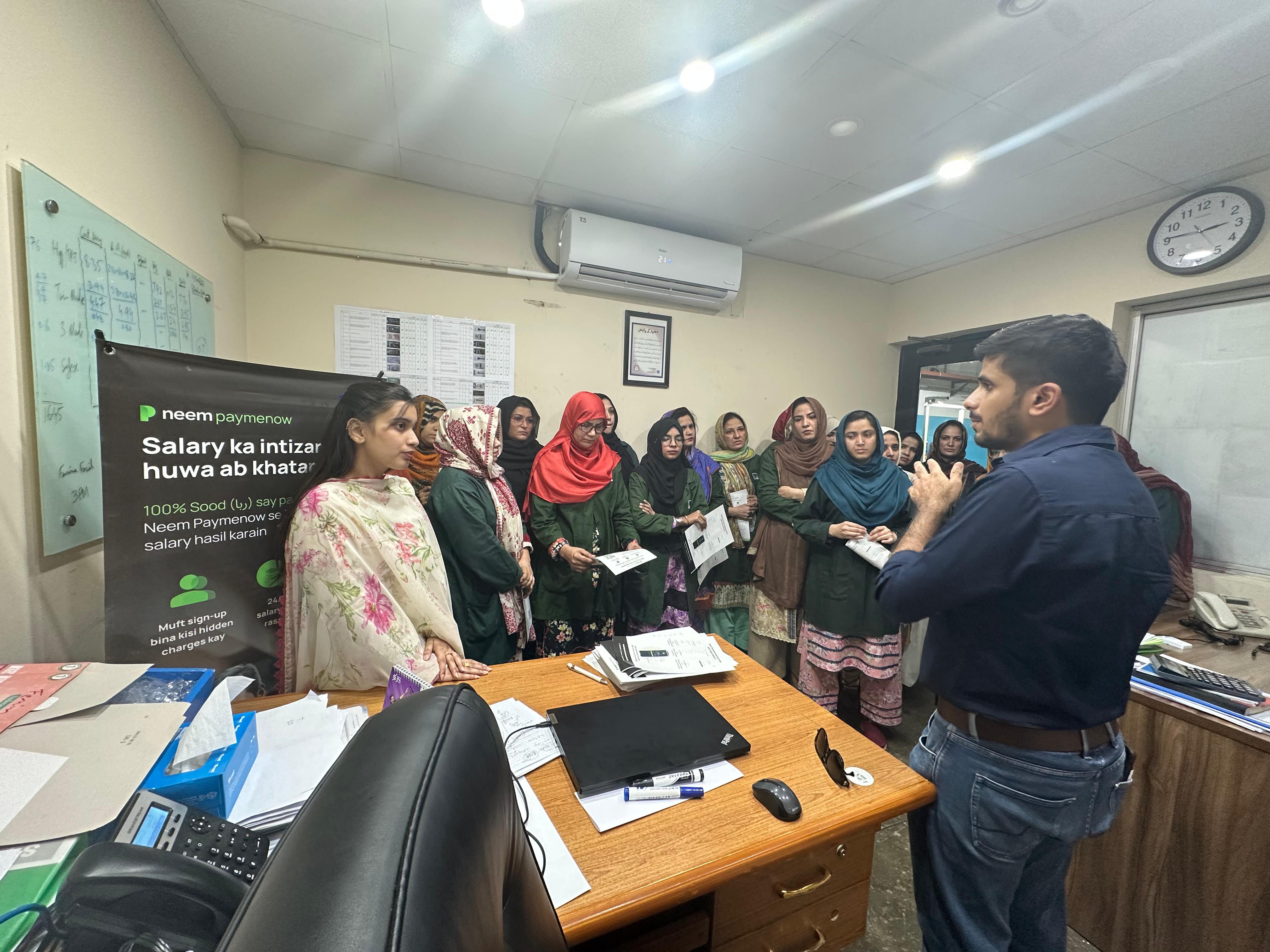
Across activation sessions run with partner companies, the pattern that shows up most often is need based, not habitual. A medical expense in the middle of the month. A school fee due before the pay cycle ends. A rent payment that lands awkwardly against a salary date. These are timing gaps, not ongoing financial distress, and they are exactly what earned wage access is built to solve.
Mature EWA markets outside Pakistan show a similar pattern. Employees who have access to earned wages tend to use it occasionally, around specific expense timing, rather than every pay cycle. Removing the pressure of a fixed payday, rather than replacing the payday altogether, is what tends to reduce the underlying financial stress that drives repeat borrowing in the first place.
Access alone does not build financial resilience. That is why the Neem Paymenow app includes financial literacy modules covering saving, budgeting, and everyday spending decisions, built directly into the same app employees use to access their salary.
The objective is to reduce reliance on early access over time, not to normalise it. An employee who understands how to plan around a pay cycle is less likely to need early access at all. Financial wellness, in this sense, is the actual product. Earned wage access is one tool inside it, not the entire offering.
HR and finance teams are not handing over a blank check when they adopt Neem Paymenow. The employer dashboard shows usage across the workforce, by department and by individual employee. Limits can be adjusted at any time, and the platform is fully Shariah compliant and SECP regulated, with no interest and no hidden charges built into any transaction.
This gives employers the ability to monitor whether usage patterns are healthy across their organisation, and to intervene early if a specific team or individual shows signs of financial strain that a benefit alone cannot solve.
Dependency is a legitimate concern to raise before adopting any financial wellness benefit, and it is one every serious platform should be able to answer directly rather than dismiss. The answer for Neem Paymenow lies in the structure: capped access, automatic reconciliation, employer level controls, and financial education built into the same product.
If your organisation is evaluating earned wage access in Pakistan and this is the question holding up the decision, book a demo at paymenow.neem.io to see exactly how the controls work in practice.
FROM THE BLOG

.png)


%20(1).png)
.png)